Back to Resources
Can You Get a Mammogram With Breast Implants? What to Know Before You Book
Yes, you can get a mammogram with implants. Learn how implant displacement views work, what implants can hide, and when supplemental ultrasound helps.
Share on:

If you have breast implants and you’re due for screening, you’ve probably wondered whether a mammogram is even possible, or safe. It’s one of the most common questions we hear, and the short answer is reassuring: yes, you can get a mammogram with breast implants, and if you’re 40 or older, you still should.
But there’s more to know before you book. Implants change how the exam is done, how much of your breast the images can show, and what supplemental options are worth considering. Here’s the full picture.
Can you get a mammogram with breast implants?
Yes. Having implants does not disqualify you from a mammogram, and it does not make the exam unsafe. Women with implants follow the same screening guidelines as everyone else. The main difference is technique.
When you have breast augmentation, the radiology team takes extra images. Alongside the standard views, a technologist trained in imaging implants performs implant displacement views (sometimes called the Eklund technique), gently easing the implant back toward the chest wall so more of your natural breast tissue can be seen in front of it. So a breast augmentation mammogram usually means more images and a little more time, not a different machine.
The single most useful thing you can do: tell the facility you have implants when you book. That lets them schedule extra time and assign a technologist experienced with breast implants mammography, so you get the most complete images possible.
How painful is a mammogram with implants?
This is the other big question, so let’s be straight about it. A mammogram uses compression, and how painful a mammogram with implants feels varies from person to person. For most women it’s brief, firm pressure and mild discomfort rather than true pain, and the implant-displacement views are done with care.
A common worry is whether compression can rupture an implant. That risk is low. Technologists who image implants are trained to apply gentler, controlled compression, which is exactly why telling them in advance matters. If you have any concern about your implants, raise it before the exam so the team can adjust.
If discomfort is what has kept you from screening, that’s worth naming out loud, because there are radiation-free, compression-free supplemental options, covered below, that many women with implants find far more comfortable.
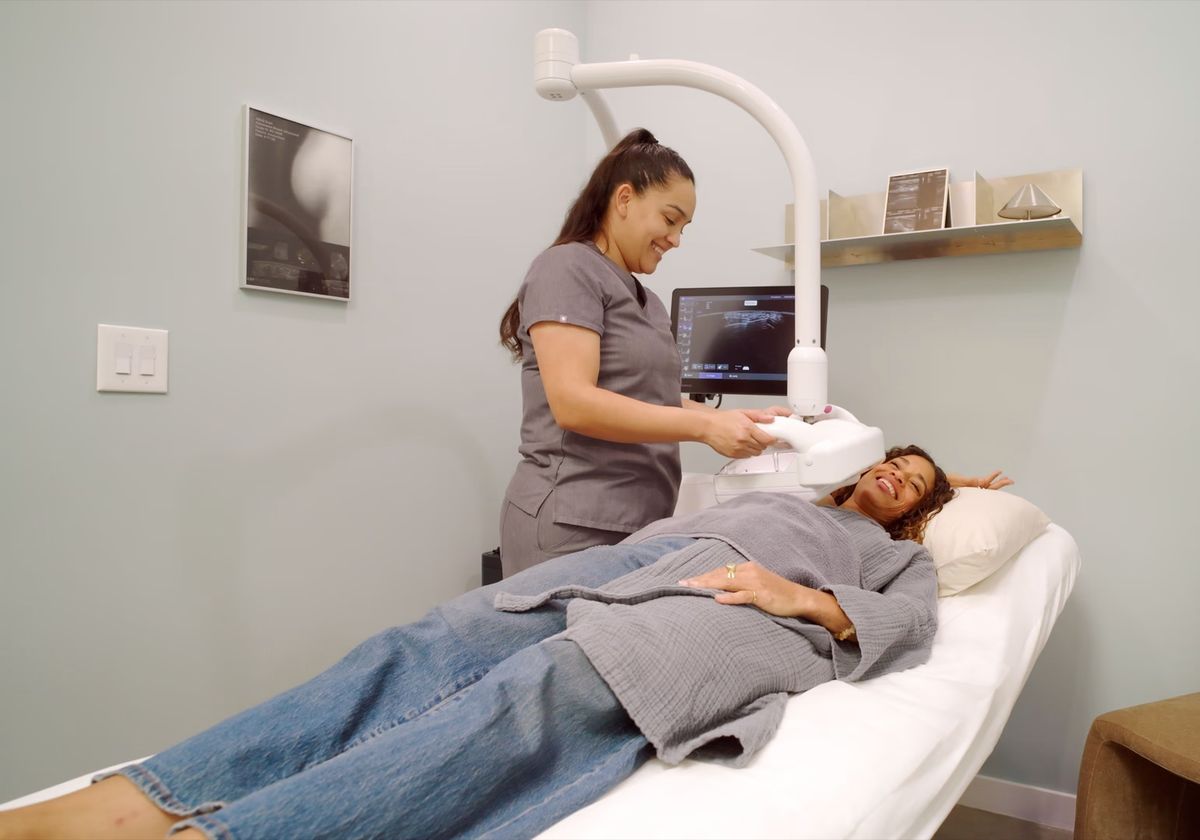
No compression means no pressure on your implant: the whole breast imaged in about 20 minutes, reviewed by a board-certified physician.
What implants can hide, and why it matters
Even with expert technique, an implant can block part of the breast on a mammogram. Displacement views recover a lot of that tissue, but not always all of it. On top of that, many women who choose augmentation also have dense breast tissue, which is its own screening challenge: on a mammogram, dense tissue and tumors both appear white, so small cancers can blend in. In extremely dense breasts, mammograms may miss up to 50% of the cancers that are present (Kolb et al., Radiology 2002; FDA, March 2023).
Since September 10, 2024, the FDA requires that women be told their breast density after a mammogram. If you have implants and dense tissue, that’s two reasons a single mammogram may not tell the whole story, and a good reason to ask your provider about adding a supplemental layer.
Ultrasound vs. mammogram for breast implants
This is where the ultrasound vs mammogram for breast implants question comes in, and the honest answer is that they do different jobs and work best together.
A mammogram remains the foundation of screening and is still recommended for women 40 and older, implants or not. Ultrasound adds something a mammogram can’t: it uses sound waves instead of X-rays, needs no compression, and can image the breast tissue around an implant without the same blind spots. That makes it a comfortable, radiation-free complement, not a replacement.
A quick note on the implants themselves: if the question is implant integrity, such as a suspected rupture, MRI is the gold standard. Ultrasound can offer meaningful information about both breast tissue and implant integrity, but it isn’t a substitute for MRI when rupture is the specific concern. For routine screening of the breast tissue, though, ultrasound is a strong, gentle supplement.
Explore a comfortable, compression-free scan that complements your mammogram, with no radiation and gentle on tissue around an implant.
ABUS vs. traditional handheld ultrasound
If you do add ultrasound, it’s worth knowing that not all ultrasound is the same. There are two very different kinds, and the difference matters for implant patients.
A traditional handheld ultrasound is performed by a sonographer moving a probe by hand while watching a live 2D screen. It is operator-dependent, so how much gets captured, and how consistently, depends on who is holding the probe. It’s excellent for a targeted look at one specific area.
An automated breast ultrasound (ABUS) works differently. A large, curved transducer sweeps across the whole breast along a set path and records a standardized, high-resolution 3D volume, the same complete view every time, for every patient. For someone with implants, that means consistent whole-breast coverage and images that can be lined up against future scans to track any change reliably.
BeSound uses ABUS with QVCAD, the first FDA PMA-approved AI system for concurrent reading of ABUS exams. AI-assisted reading flags areas for closer review, and a board-certified physician always makes the final assessment.
A gentler, radiation-free supplemental layer
For women with implants, the appeal of ABUS is straightforward. There’s no compression, so the worry about pressure on an implant goes away. There’s no radiation. And because ABUS uses sound waves, it’s safe for repeated use. It is the first FDA-approved automated breast ultrasound system for supplemental screening in women with dense breast tissue, which describes many implant patients.
When added to mammography, automated breast ultrasound detects 35.7% more breast cancers than mammography alone (FDA PMA P110006). It works alongside your mammogram, not instead of it: the mammogram as your foundation, and a comfortable, radiation-free scan to see what dense tissue or an implant might obscure.
A BeSound scan takes about 20 minutes, your images are reviewed by a board-certified physician, and results land in your secure portal within 24 to 48 weekday hours. Pricing is transparent at $349.
Getting screened in Los Angeles
If you have implants and want a gentler, radiation-free supplemental scan, BeSound offers automated breast ultrasound in Los Angeles. Our flagship location on Melrose Avenue was built for comfort: an all-female sonographer team, warm and private rooms, and an unhurried experience that feels nothing like a sterile hospital wing.
About 20 minutes. Radiation-free and compression-free. Reviewed by a board-certified physician, with results in 24 to 48 weekday hours. Transparent pricing at $349.
Not medical advice. Consult a medical professional with any medical questions. BeSound provides supplemental breast ultrasound imaging and does not replace mammography or medical care. Imaging is interpreted by licensed physicians. For marketing purposes only. The American Cancer Society recommends that women at average risk begin regular mammograms at age 40. BeSound is a technology platform that connects individuals with independent partner medical groups that provide breast imaging services; BeSound is not a healthcare provider.
Read more



Start your BeSound journey
Book your scan and view your results directly in your BeSound dashboard.
Learn your risk
Not sure where to start? Take our free risk assessment to better understand your personal risk factors.