Back to Resources
July 7, 2026
Tyrer-Cuzick Explained: What Your Risk Number Means
Your Tyrer-Cuzick score offers a clearer picture of your personal breast cancer risk. Learn what it means, how breast density fits in, and how BeSound helps you take the next step.
Share on:
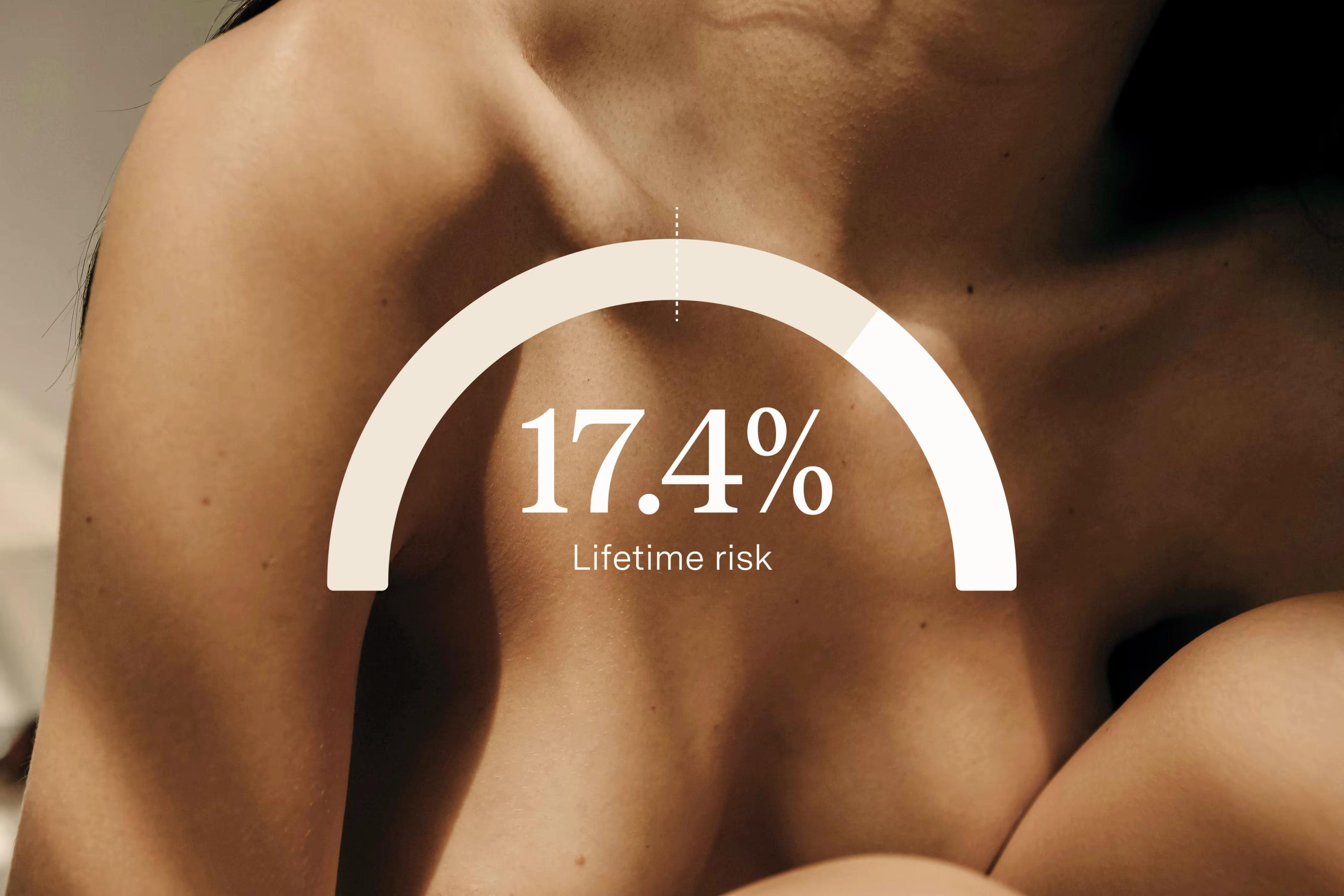
Somewhere between your annual mammogram and a late-night search spiral, you probably ran into a phrase that sounds like a law firm: Tyrer-Cuzick.
Maybe a provider mentioned it. Maybe it showed up in an article about dense breasts. Maybe you took a risk assessment online and got a number back with a decimal point in it, and now you're staring at it, unsure whether it's good news, bad news, or just news.
Here's the reassuring part: a Tyrer-Cuzick score isn't a diagnosis, a prediction, or a verdict. It's context. It's a way of turning your personal history into a number your provider can actually use to build a screening plan around you, instead of around the average woman. Let's walk through what it is, what it asks, and what to do with the answer.
What is the Tyrer-Cuzick model?
The Tyrer-Cuzick model is a clinically validated breast cancer risk assessment tool, and one of the most widely used breast cancer risk calculators in clinical practice. It's named for the two researchers who developed it, Jack Cuzick and Jonathan Tyrer, and you'll also see it called the IBIS risk calculator (formally, the IBIS Breast Cancer Risk Evaluation Tool). Same thing, two names, which is exactly the kind of detail that makes this topic feel harder than it is.
What it does is straightforward. You answer a set of questions about your health history. The model runs those answers against decades of population data and returns two estimates:
- Your lifetime risk: the estimated probability that you'd be diagnosed with breast cancer over the course of your life.
- Your 10-year risk: the estimated probability for the decade ahead, which is often the more useful number for planning what to do now.
Most tools also show you how your estimate compares to the average woman your age. That comparison is usually the moment the number stops feeling abstract.
What the Tyrer-Cuzick risk assessment asks you
If you've wondered what a Tyrer-Cuzick calculator actually wants from you, it's less invasive than you'd think. No blood draw, no imaging, no appointment. The assessment looks at factors like:
- Age and reproductive history. When you had your first period, whether and when you've given birth.
- Hormonal factors. Menstrual history and hormone use.
- Family history of breast and ovarian cancer. Not just whether, but who, and at what age. This is where Tyrer-Cuzick goes deeper than most tools.
- Body mass index.
- Previous breast biopsies or benign breast conditions.
- Genetic testing results, if you have them. And if you don't, that's fine, the model estimates the likelihood of carrying certain mutations from your family history instead.
It takes about five to seven minutes. That's the whole ask.
What is a good Tyrer-Cuzick score?
This is the most-searched question about the model, and the honest answer is that "good" isn't quite the right frame.
Your score isn't a grade. It's a percentage estimate, and its meaning depends entirely on context: your age, your history, and the guidelines your provider works from. National guidelines sort women into general categories, roughly average risk, intermediate risk, and high risk, and where those lines fall, including what counts as a high Tyrer-Cuzick score, is a clinical judgment call your provider is trained to make, not one to make alone at your kitchen table at 11pm.
What a number can do is unlock a real conversation. A woman with an average-risk estimate and a woman with an elevated one may have meaningfully different screening plans, and neither of them would know that without running the assessment first. The point isn't the number. It's what the number lets you ask for.
Two things worth holding onto:
A risk estimate is not a prediction. Plenty of women with elevated estimates never develop breast cancer. The model describes probability across populations, not certainty about you.
Risk isn't fixed. Your estimate can shift as your age, family history, hormonal factors, or breast density change. It's worth retaking the assessment when something meaningful changes, and for those at intermediate or high risk, checking in annually is reasonable.
"I don't have a family history, so this doesn't apply to me"
This is the single most common reason women skip a risk assessment entirely, and it's worth pausing on.
About 85% of breast cancers occur in women who have no family history of the disease (Breastcancer.org, updated 2026). And 90% of women diagnosed with breast cancer test negative for BRCA mutations (National Breast Cancer Foundation, 2025).
Which means a clean family tree and a negative genetic test are genuinely good news, and also not a plan. "I'm not high risk" is an assumption until you've actually run the numbers. That's the entire reason these tools exist.
Where breast density fits into your risk
Breast density deserves its own mention here, because it's a risk factor a lot of women don't learn about until a letter shows up after their mammogram.
Nearly half of all women 40 and older who get mammograms are found to have dense breast tissue (National Cancer Institute, 2024). And women with dense breast tissue are four to six times more likely to develop breast cancer than women with non-dense breasts (Boyd et al., NEJM 2007).
There's a second issue that a risk score alone won't capture: dense tissue and tumors both appear white on a mammogram, which makes cancer harder to see. In extremely dense breasts, mammograms may miss up to 50% of the cancers that are present (Kolb et al., Radiology 2002; FDA, March 2023).
So your risk number tells you how much attention your screening plan deserves. Your density tells you how well your current screening can actually see. Those are two different questions, and you want the answer to both.
What to do with your number
Knowing your risk isn't the finish line. It's the part that makes everything after it more useful.
- Take the assessment. It's five to seven minutes, and it's free.
- Bring your results to your provider. They can tell you what your risk level means for you specifically and what your screening plan should look like.
- Keep getting your mammograms. If you're 40 or older, mammography remains the foundation. Nothing here replaces it.
- Ask about supplemental screening, especially if you have dense tissue. When added to mammography, automated breast ultrasound detects 35.7% more breast cancers than mammography alone (FDA PMA P110006).
And the reason any of this matters: when breast cancer is caught at the localized stage, the five-year survival rate is over 99% (ACS Cancer Facts & Figures 2026). Early detection is the whole game, and complete screening is how you play it.
Know your risk, then close the gap, in Los Angeles
At BeSound, we offer the Tyrer-Cuzick risk assessment for free, to anyone, whether or not you ever book a scan with us. It takes about five to seven minutes and gives you your estimated 10-year and lifetime risk, plus how it compares to the average woman your age. No cost, no catch. We think every woman should be able to answer "what's my risk?" without a referral or a fight.
And if your assessment or your mammogram report points to dense tissue, BeSound offers FDA-approved automated breast ultrasound in Los Angeles, specifically cleared for supplemental screening in women with dense breast tissue. It's radiation-free, compression-free, about 20 minutes, $349 flat, and your images are reviewed by a board-certified physician with results in your secure portal within 24 to 48 weekday hours. It's supplemental, working alongside your mammogram rather than instead of it. And it's available for women under 40 who want proactive screening, too.
Start with the number. Learn your personal risk for free, or book your scan in Los Angeles.
You deserve to know where you stand, and what to do about it.
For women 18 and older. Not medical advice. Consult a medical professional with any medical questions. The Tyrer-Cuzick risk assessment is an educational tool that provides statistical estimates based on population data; it does not constitute medical advice, diagnosis, or treatment, and does not replace professional medical evaluation. BeSound provides supplemental breast ultrasound imaging and does not replace mammography or medical care. Imaging is interpreted by licensed physicians. For marketing purposes only. The American Cancer Society recommends that women at average risk begin regular mammograms at age 40. BeSound is a technology platform that connects individuals with independent medical groups that provide breast imaging services; BeSound is not a healthcare provider.
Read more



Start your BeSound journey
Book your scan and view your results directly in your BeSound dashboard.
Learn your risk
Not sure where to start? Take our free risk assessment to better understand your personal risk factors.